La Maddalena Boat Trips and Beaches: Spargi, Budelli, the Pink Beach and Cala Coticcio
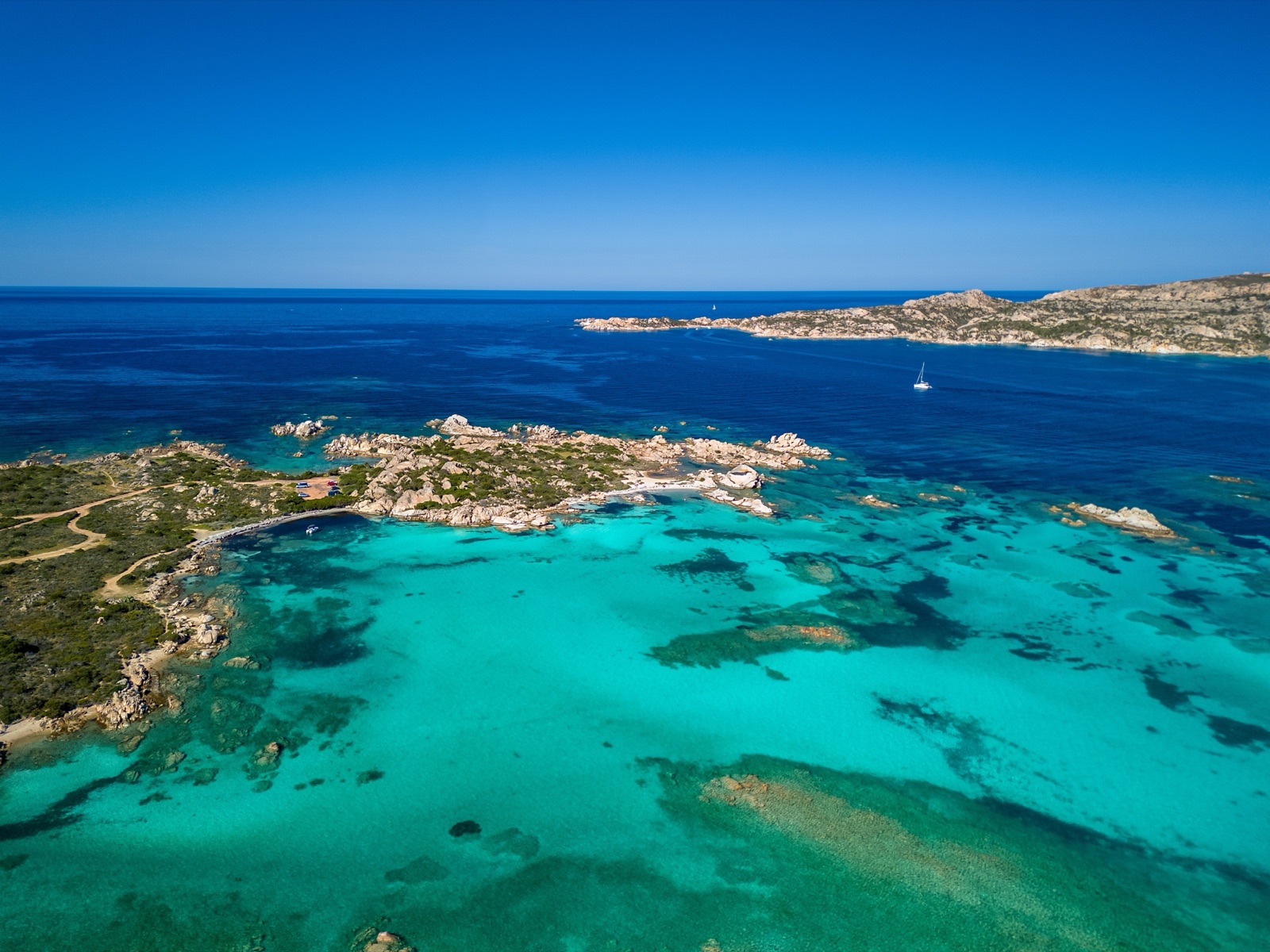
The La Maddalena archipelago is best seen from the water. Its most famous beaches lie on uninhabited islands with no roads and no ferries, and the colours that make it famous — turquoise shallows, white sand, pink-tinged granite — are at their most intense when you look down into them from a boat. A day on the water, hopping between swim stops, is the classic way to experience the park.
This guide describes the islands and beaches the boat trips visit, from Cala Corsara on Spargi to the protected Pink Beach of Budelli and the guided-only coves of Caprera, compares the main trips, and explains the park rules that keep these places as they are.
Why go by boat
- The archipelago has more than 60 islands and islets, and only La Maddalena and Caprera are linked by road.
- About 78% of the park is sea, and it is part of the sanctuary for marine mammals.
- Spargi, the archipelago’s third-largest island, can be reached only by sea.
For anyone without their own boat, a day trip from Palau, La Maddalena or Cannigione is the way to reach the outer islands.
Spargi
The island
Spargi is a wild granite island covered in scrub, with its best beaches on the side facing La Maddalena. Spargi, the archipelago’s third-largest island, can be reached only by sea; its east side has Cala Corsara, Cala Granara and Cala Ciaccaro. Spargi’s wind-carved granite includes the famous Witch and Bulldog rocks — part of the fun is spotting the shapes as the boat approaches.
Cala Corsara
The most famous beach on Spargi, and one of the favourite stops of the day boats. Cala Corsara, on Spargi’s south coast, is four beaches of very fine white sand among dunes, with the ‘Witch Rock’ on its western side, and is good for snorkelling. The water shades from turquoise over the sand to deep blue over the rocks. Because it is a popular stop, it can be busy in the middle of the day in August; the trips that arrive earlier or later in the day find it calmer. Walk a little way along the four beaches and you can usually find a quieter patch of sand, and the granite at either end is good for exploring with a mask. Remember that nothing may be taken away: sand, shells and stones all stay on the island.
History under the sand and sea
Spargi has been a refuge for sailors for thousands of years. On Cala Corsara beach a tafone, a rock shelter, was used from the Neolithic to the start of the Nuragic period. Offshore lies a famous find: in 1939 a diver found a Roman ship of about 110 BC on the Corsara shoal at 18 m; around 2,000 amphorae and ceramics are now in the Nino Lamboglia naval museum on La Maddalena.
Birds
To the north-west, the islets of Spargiotto and Spargiottello are protected nesting sites for seabirds such as Audouin’s gull and shearwaters. Boats keep their distance, but binoculars reward a look.
Budelli and the Pink Beach
Where it is
The Pink Beach is at Cala di Roto, on the south-east of Budelli. It is the most famous beach in the archipelago — and one that nobody may set foot on.
Why it is pink
Its colour comes from the shells of Miniacina miniacea, a foraminifer that lives on Posidonia rhizomes; skeletons of marine micro-organisms make up as much as 80–90% of the sand. The tiny pink fragments, mixed with white, give the beach its famous blush.
Why it is closed
The beach is in the park’s zone of full protection, and since 1994 access, transit, stopping and bathing have been forbidden; it can be admired only from the sea. The protection came partly because of visitors: the pink sand was also stolen, one of the reasons it was protected.
Seeing it
Boats may pass only slowly, up to the buoys about 70 m from the shore that close the bay. The catamaran tour includes a look at the Pink Beach, and the sailing trips to Budelli pass close by.
The natural pools
Among the outer islands, the shallow, luminous waters known as the natural pools are one of the highlights of a boat day:
- The Cannigione cruise spends 1.5 hours at the natural pools of Porto della Madonna.
- The sailing tour visits Spargi and Budelli and the natural pools of Budelli, with swims and snorkelling.
The water here is shallow and clear enough to see the sandy bottom from the deck.
Budelli beyond the famous beach
Budelli is more than its Pink Beach. The boats that visit it combine the view of Cala di Roto with swims in the waters around the island and, on the sailing tour, the natural pools of Budelli. Seen from the water, its granite shores and scrub-covered slopes show how the whole archipelago looked before tourism: wild, quiet and shaped by wind and sea. Staying on the boat, or in the water where swimming is allowed, is the way to enjoy it.
Santa Maria
Santa Maria is one of the beaches visited by the full-day boat trip from Palau, together with Cala Corsara, and a classic swim stop on the outer-islands circuit.
Caprera’s coves
Cala Coticcio
Caprera, linked to La Maddalena by road, has some of the most beautiful coves in the park, and two are specially protected. Cala Coticcio and Cala Brigantina on Caprera lie in highly protected zones and can be reached on foot only with a licensed environmental hiking guide. Each visitor also pays a €3.00 environmental contribution to the park (children up to 12 are exempt), separate from the guide’s fee and not refunded if the walk is cancelled.
From the water
The full-day boat trip from Palau includes the clear water of Cala Coticcio, letting you see the cove from the sea without the guided walk.
Cala dell’Amore
The Cannigione cruise includes a swim at Cala dell’Amore, one of the stops on its route through the archipelago.
The beaches of La Maddalena island
If you are staying on the main island, you do not need a boat for a swim: the island’s beaches include Bassa Trinita and Spalmatore.
Getting to the departure ports
- Palau is the main hub on the Sardinian coast. Ferries link La Maddalena with Palau, 40 km from Olbia; Olbia airport is just over 40 km from Palau.
- La Maddalena town is a short ferry ride from Palau: ferries leave Palau from 06:30 until 20:00, roughly every half hour, in the summer timetable.
- Cannigione lies further along the Gallura coast, the base for the three-deck cruise.
- Baja Sardinia and Santa Teresa Gallura are other popular ports for trips into the park.
See our guide to getting to La Maddalena for the ferries, the causeway to Caprera and more.
The boat trips compared
Full-day boat trip from Palau. A day boat from Palau or La Maddalena to beaches such as Cala Corsara and Santa Maria, the clear water of Cala Coticcio, and time in La Maddalena town. Several swim stops. About 7 hours.
Catamaran tour with lunch. A catamaran from Palau with swim stops at three islands, commentary from the captain, a look at the Pink Beach, and lunch with wine. About 7 hours.
Island-hopping sailing tour with lunch. A sailboat from La Maddalena or Palau to Spargi, Budelli and the natural pools of Budelli, with swims, snorkelling, lunch and drinks. About 6.5 hours.
Full-day cruise from Cannigione. A three-deck boat from Cannigione with a swim at Cala dell’Amore, 1.5 hours at the natural pools of Porto della Madonna and free time in La Maddalena town. About 8 hours.
Four-hour RIB tour. A fast inflatable boat from Palau or La Maddalena around the smaller islands of the marine park, skipper-guided, with swims in the clear water. About 4 hours.
The tours page lists them all with live prices.
Which to choose
- For a relaxed day with lunch: the catamaran or the sailing tour.
- For the natural pools: the Cannigione cruise, or the sailing tour to Budelli.
- For a half day: the RIB tour.
- For beaches plus town: the full-day boat from Palau or the Cannigione cruise.
- For sailing itself: the island-hopping sailing tour.
What the park protects
The beaches are only part of the story. The national park was established by Law no. 10 of 4 January 1994, and the park covers 5,100 ha of land and 15,046 ha of sea along 180 km of coast. On land, the islands are covered in Mediterranean scrub of myrtle, juniper, strawberry tree, lentisk, helichrysum, heather, broom and rock rose. Overhead and on the rocks, seabirds include Scopoli’s shearwater, Audouin’s gull, yellow-legged gull, storm petrel and shag. The rules that keep boats out of certain coves and people off the Pink Beach exist so that all of this survives the summer crowds.
Under the water
The park’s sea is as rich as its beaches. More than 110 species of land vertebrates and some 500 marine species live in the park, including the strictly protected dusky grouper. Posidonia meadows, the seagrass that also makes the Pink Beach’s sand, cover large areas of the seabed. The snorkelling stops on the sailing tour and the swim stops elsewhere give a glimpse of this world; bring a mask if you have one.
The rules on the water
- In the zones of full marine protection, navigation, anchoring, swimming and fishing are forbidden; the Pink Beach is an example.
- Boaters need a park permit to navigate, moor, anchor or stop within 300 m of the coast; kayaks, pedalos and windsurf boards are exempt.
- Since summer 1999 the park has charged a ticket to private boaters, passenger boats, dive centres and divers; on a tour, the operator takes care of it.
- Never take sand, shells or stones, and keep off the protected beaches.
A typical day on the water
Every trip is different, but most full days follow a similar rhythm.
- Morning departure from Palau, La Maddalena or Cannigione, with a first stretch of open water among the islands and the captain or guide pointing out landmarks.
- The first swim stop, usually at a sheltered cove with clear, shallow water, where you swim from the boat or the beach.
- More islands, with a slow pass by the protected shores and a stop at a second beach or the natural pools.
- Lunch, either on board on the trips that include it or ashore on those that stop in town.
- Afternoon swims and a last stop, then the ride back in the late-afternoon light.
On the half-day RIB tour the same pattern is compressed into about 4 hours, with faster crossings and fewer long stops.
When to go
- July and August bring the warmest water and the most trips, but also the busiest beaches and boats. Book ahead and choose weekdays if you can.
- June and September are often the best compromise, with warm water and more space.
- Spring and autumn can be beautiful, but fewer trips run, and the weather is more changeable.
- Windy days can change routes or cancel trips at any time of year; operators may adapt the route to the conditions on the day.
Photography from the boat
- Look down: the colours of the shallows are the archipelago’s signature, best seen from the bow.
- Granite shapes: Spargi’s Witch and Bulldog rocks and the wind-carved boulders everywhere.
- The Pink Beach: from the buoys, a zoom lens helps.
- Protect your gear: spray and sand are constant companions, so bring a dry bag.
Tips for a boat day
- Book ahead in July and August.
- Bring swimwear, a towel and a mask for the snorkelling stops.
- Use reef-safe sun protection and wear a hat; there is little shade on deck.
- Carry water, even on trips with lunch.
- Check the sea forecast: strong winds can change the route or cancel trips.
- Bring a light layer for the ride back, when the breeze picks up.
Staying safe in the water
- Listen to the crew’s briefing at each stop; they know where currents and boat traffic are.
- Swim within your limits, and use a float or life jacket if you are not confident.
- Watch for other boats when swimming away from your own, especially at busy coves.
- Protect yourself from the sun, which reflects strongly off the water and pale sand.
- Drink regularly; a day on the water is more tiring than it feels.
With children
Boat days are a highlight for children: swimming from the boat, spotting shapes in the rocks and looking for fish. Choose a trip whose length suits them — the 4-hour RIB tour for younger children, a catamaran with lunch for a full day — and check that life jackets in their size are on board. For the guided walk to Cala Coticcio, children up to 12 are exempt from the park contribution.
Accessibility
Boarding and swim stops usually involve steps, gangways and ladders, which can be difficult for people with limited mobility. Larger boats, such as catamarans and the Cannigione cruise boats, tend to be easier than sailing boats and RIBs; ask the operator before booking. The walk to Cala Coticcio is on rough terrain.
Frequently asked questions
Can you swim at the Pink Beach?
No. Since 1994, access, transit, stopping and bathing at the Pink Beach have been forbidden. It can be seen only from the sea, from boats passing slowly up to the buoys about 70 m from shore.
Why is the Pink Beach pink?
Its colour comes from the shells of Miniacina miniacea, a foraminifer that lives on Posidonia; skeletons of marine micro-organisms make up as much as 80–90% of the sand.
Which boat trip goes to the natural pools?
The Cannigione cruise spends 1.5 hours at the natural pools of Porto della Madonna, and the sailing tour visits the natural pools of Budelli.
Can I visit Cala Coticcio?
On foot, only with a licensed environmental hiking guide, plus a €3.00 park contribution (children up to 12 exempt). The full-day boat from Palau visits its clear water from the sea.
How long are the boat trips?
From about 4 hours for the RIB tour to about 8 hours for the Cannigione cruise; the catamaran and the boat from Palau take about 7 hours, the sailing tour about 6.5.