La Maddalena Town and Caprera: Nelson's Church, Napoleon's First Battle and Garibaldi's Island Home
Most visitors to the La Maddalena archipelago come for the beaches and the boats, and many see the town only in passing on a day trip. That is a pity. La Maddalena is a lively island town with a history out of all proportion to its size — Napoleon fought his first battle here, Nelson based his fleet in its waters, and Giuseppe Garibaldi, the hero of Italian unification, chose neighbouring Caprera as his home. A day on land, across the causeway to Caprera, is the perfect counterpoint to a day on the water.
This guide covers La Maddalena town, its history and its church, and the island of Caprera with Garibaldi’s home, the Memoriale and the guided walks to its protected coves.
La Maddalena town at a glance
- La Maddalena has 10,449 inhabitants (2026).
- The town is just 2 km from the north-eastern shore of Sardinia.
- La Maddalena lies 2 km from the Sardinian shore and is linked by a causeway to Caprera.
- Ferries link La Maddalena with Palau, 40 km from Olbia, and ferries leave Palau from 06:30 until 20:00, roughly every half hour, in the summer timetable.
A town shaped by the sea and the navy
Names and beginnings
The Romans called the island Ilva, Fussa and Bucina; it took the name Santa Maria Magdalena in the 16th century. Its position in the Strait of Bonifacio, through which much shipping must pass, made the archipelago a strategic military position, and that position has shaped its history ever since.
The Savoy town
In 1767 the Savoy-Piedmontese occupied the island, and the present town grew from then.
Napoleon’s first battle
In 1793 a French expedition including Napoleon Bonaparte tried and failed to take the island; it was his first combat experience. The young officer who would one day rule most of Europe began his military career with a defeat here.
Nelson’s anchorage
A decade later, the British were here. During the Napoleonic Wars, Nelson used the archipelago as a base for his fleet. He left a lasting mark on the town’s church, as you will see below.
The navy
The Italian Royal Navy established a base here in 1887, and the navy remains part of the town’s identity. The Admiralty building houses the Italian Navy’s Petty Officer School.
A famous prisoner
During the Second World War, the island briefly held one of the era’s most famous prisoners: in 1943 Mussolini was briefly held prisoner at Villa Webber, from 7 to 27 August.
Walking the town
The centre
The centre of town life is Piazza Umberto I, joined to the port by Via Garibaldi, lined with shops, restaurants and bars. Piazza Umberto I was formerly known as Piazza Comando, a name older islanders still use. From the port, a stroll along Via Garibaldi, through the narrow streets behind it and out to the harbour of Cala Gavetta makes an easy hour.
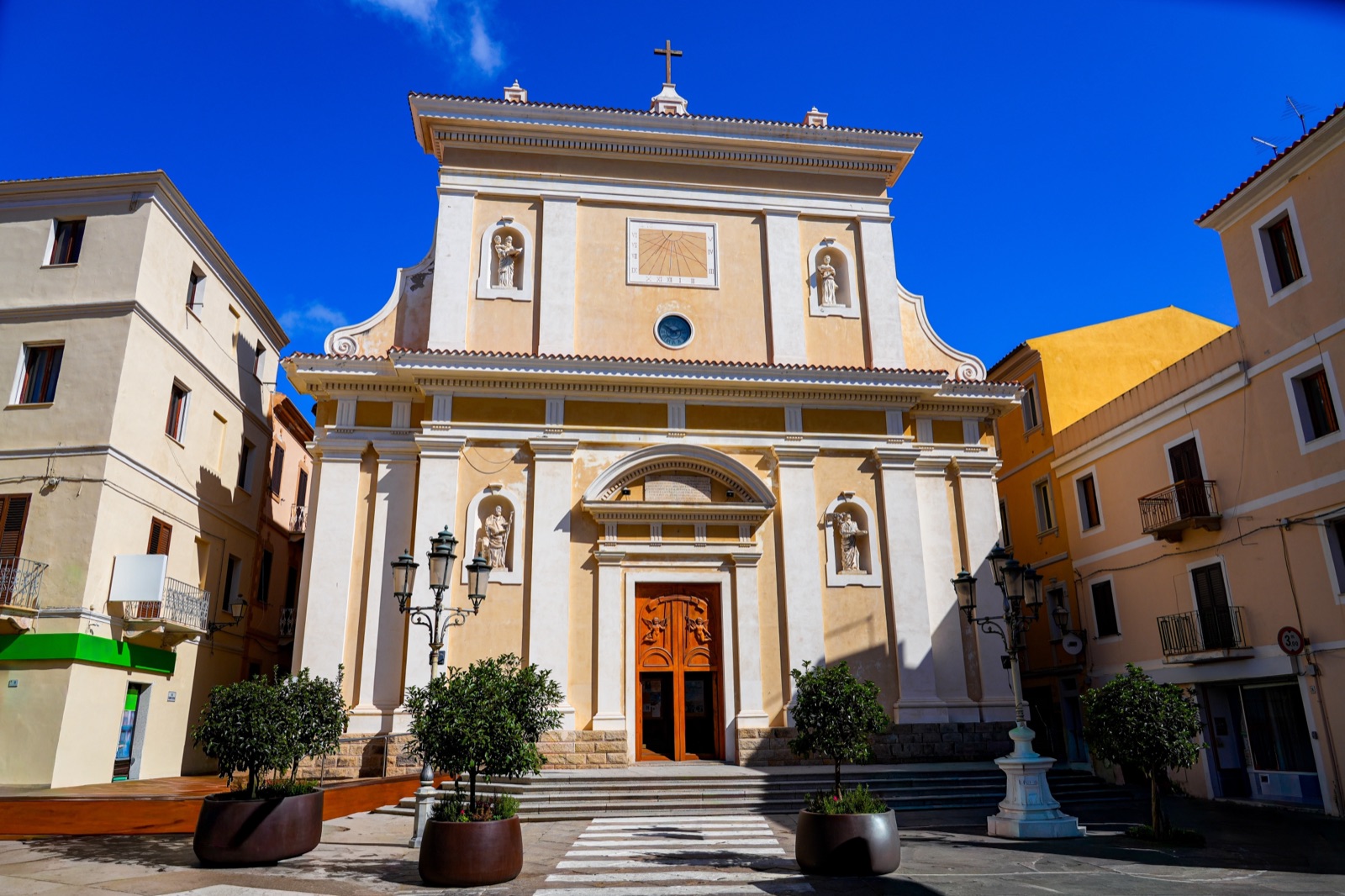
The church of Santa Maria Maddalena
The town’s main church is dedicated to its patron saint.
- The church of Santa Maria Maddalena, built between the late 18th and early 19th centuries, keeps gifts from Admiral Horatio Nelson, including a crucifix and silver candlesticks.
- The church stands in its own square, a short walk from Cala Gavetta, and was built with the help of the islanders and the Savoy garrison.
- Above the choir is a late-18th-century wooden statue of Mary Magdalene from Liguria, and there are paintings attributed to Antonio Cano.
- The patron saint’s feast is on 22 July, and the Diocesan Museum next to the church holds its treasure.
Nelson’s gifts are a remarkable link between this small Sardinian island and one of the great figures of European naval history. Inside, look for the high altar and the statue above the choir, then visit the Diocesan Museum next door for the rest of the church treasure. Remember that the church is a place of worship: dress respectfully, keep your voice down, and avoid visiting during services. If you are in town on the patron saint’s feast, the church is the heart of the celebrations, and a visit that day gives a real sense of how much it still means to the islanders.
The naval museum
The sea around the archipelago has yielded treasures of its own. In 1939 a diver found a Roman ship of about 110 BC on the Corsara shoal at 18 m; around 2,000 amphorae and ceramics are now in the Nino Lamboglia naval museum on La Maddalena.
Beaches near town
For a swim between sights, the island’s beaches include Bassa Trinita and Spalmatore.
The town and its islands
La Maddalena is not just the name of the town and the main island: the municipality covers the whole archipelago, including Budelli, Caprera, Maddalena, Mortorio, Razzoli, Santa Maria, Santo Stefano, Spargi and many smaller islets. In a sense, the town is the capital of a small island world, and its port is where the boats to the outer islands, the ferries to Palau and the fishing and navy vessels all meet.
When to visit the town
- Summer brings the ferries, the boat trips and the crowds; the town is at its liveliest in the evenings, when the day visitors have gone.
- 22 July, the patron saint’s feast, is the town’s big day.
- Spring and autumn are ideal for Caprera: the walks are cooler and the Compendio quieter, though museum hours change with the season.
- Winter is quiet, with the town returning to its everyday rhythm and the ferries still running.
Caprera
Getting there
Caprera is linked to La Maddalena by a causeway, so you can reach it by car, scooter or bicycle. A vehicle is essential for the Memoriale, which is some distance from the Compendio.
The island
Caprera is greener and wilder than La Maddalena. Caprera has large pine woods; legend says Garibaldi planted the first pine near his home. Caprera has a population of wild goats of unknown origin, genetically distinct from Sardinian goats, and you may meet them among the pines.
Nature on Caprera
Caprera is part of the national park, and its landscape shows why. The islands are covered in Mediterranean scrub of myrtle, juniper, strawberry tree, lentisk, helichrysum, heather, broom and rock rose, and the pines give way to granite headlands above clear water. From the higher ground, the views stretch across the archipelago. Seabirds include Scopoli’s shearwater, Audouin’s gull, yellow-legged gull, storm petrel and shag, so keep an eye on the sky and the sea as you explore.
Taking your time
It is easy to rush Caprera, seeing only the Compendio before heading back to town. Allow a whole morning or afternoon instead: visit the White House, drive on to the Memoriale, and leave time for a walk among the pines or a guided walk to one of the protected coves. The island rewards a slower pace, and its quiet roads are a pleasure after the bustle of the port.
Garibaldi’s home: the Compendio Garibaldino
The story
Giuseppe Garibaldi, the hero of Italian unification, made Caprera his home. Garibaldi lived at the Compendio from 1856 to 1882; the visit takes about 45–50 minutes, and you should arrive 10 minutes before your slot. Opened to the public in 1976, the Compendio is the most visited museum in Sardinia; Garibaldi spent the last 25 years of his life there and died in 1882.
The White House
At the heart of the Compendio is the Casa Bianca, the White House. The White House was built in 1856–57. The White House has seven interconnecting rooms — entrance hall, three bedrooms, study, dining room and kitchen — plus a later room where Garibaldi received family and friends. The original furnishings and personal belongings bring his daily life to life, and his daughter Clelia lived there until her death in 1959.
The grave
Garibaldi died on Caprera on 2 June 1882 and is buried in the small family cemetery beside the White House; the island also has the Memoriale in the former Arbuticci fort and the grave of his horse Marsala.
Visiting
- Hours and entry: the Compendio Garibaldino (the White House, grounds and cemetery) opens 08:30–19:30, last entry 18:30, with timed entry of at most 20 people every 15 minutes; booking is strongly recommended.
- Closing day: both Garibaldi museums close on Sundays, and hours vary with the season.
- Tickets: tickets for the Compendio cost €8.00 (reduced €2.00); a combined ticket with the Memoriale costs €13.00.
The Memoriale Giuseppe Garibaldi
While the Compendio shows Garibaldi the man, the Memoriale tells the story of Garibaldi the hero. The Memoriale Giuseppe Garibaldi, in the Arbuticci fort built in the late 19th century, tells his life in thirteen sections over about 60 minutes; it is about four kilometres from the Compendio and reachable only by car, motorbike or bicycle. Check the seasonal hours: from 26 October 2026 the Memoriale opens only in the morning, 8:30–13:45, last entry 13:00.
The town and its islands
La Maddalena is not just the name of the town and the main island: the municipality covers the whole archipelago, including Budelli, Caprera, Maddalena, Mortorio, Razzoli, Santa Maria, Santo Stefano, Spargi and many smaller islets. In a sense, the town is the capital of a small island world, and its port is where the boats to the outer islands, the ferries to Palau and the fishing and navy vessels all meet.
When to visit the town
- Summer brings the ferries, the boat trips and the crowds; the town is at its liveliest in the evenings, when the day visitors have gone.
- 22 July, the patron saint’s feast, is the town’s big day.
- Spring and autumn are ideal for Caprera: the walks are cooler and the Compendio quieter, though museum hours change with the season.
- Winter is quiet, with the town returning to its everyday rhythm and the ferries still running.
Caprera’s protected coves
Caprera’s coastline includes two of the archipelago’s most beautiful coves. Cala Coticcio and Cala Brigantina on Caprera lie in highly protected zones and can be reached on foot only with a licensed environmental hiking guide. Each visitor also pays a €3.00 environmental contribution to the park (children up to 12 are exempt), separate from the guide’s fee and not refunded if the walk is cancelled. Book a guide in advance and combine the walk with the Compendio for a full day on Caprera.
Seeing the islands from the water
A day in town and on Caprera pairs well with a day on the water.
Full-day boat trip from Palau. A day boat from Palau or La Maddalena to Cala Corsara and Santa Maria, the clear water of Cala Coticcio, and time in La Maddalena town. About 7 hours.
Four-hour RIB tour. A fast inflatable boat from Palau or La Maddalena around the smaller islands of the marine park, with swims. About 4 hours — ideal for a half day alongside a visit to Caprera.
The tours page lists them all with live prices, and our guide to boat trips and beaches covers the islands you reach by sea.
Photography
- The port and Cala Gavetta, with boats against the town’s façades.
- Via Garibaldi and the narrow streets behind it, especially in the evening.
- The church square, with the church of Santa Maria Maddalena.
- Caprera’s pine woods and granite, and the view back towards La Maddalena from the causeway.
- The White House on Caprera, from the grounds of the Compendio.
Eating and staying
The town is the best base on the archipelago for evenings out, with restaurants and bars around Piazza Umberto I, Via Garibaldi and the port. Staying on the island means you can visit Caprera early, before the day visitors arrive, and join boat trips that leave from La Maddalena itself. Book ahead in summer, when rooms and tables fill up.
A day on land
- Morning: across the causeway to Caprera for your booked slot at the Compendio Garibaldino; allow about 45–50 minutes.
- Late morning: on to the Memoriale in the Arbuticci fort, about four kilometres away; allow about an hour.
- Lunch: back in La Maddalena town, around Piazza Umberto I.
- Afternoon: the church of Santa Maria Maddalena and Nelson’s gifts, a walk to Cala Gavetta, and a swim at Bassa Trinita or Spalmatore.
- Evening: Via Garibaldi at dusk, or the ferry back to Palau.
Practical tips
- Book the Compendio in advance; entry is by timed slots of 20 people.
- Remember the Sunday closing of the Garibaldi museums.
- Arrange transport to Caprera, especially for the Memoriale, which is reachable only by car, motorbike or bicycle.
- Book a licensed guide for Cala Coticcio or Cala Brigantina, and pay the €3.00 park contribution.
- Visit on 22 July for the patron saint’s feast, or avoid it if you prefer a quieter town.
With children
Children usually enjoy the causeway drive to Caprera, the goats among the pines and the stories of Garibaldi. The Compendio visit is short, about 45–50 minutes, and the reduced ticket is €2.00. Pair it with a swim at a beach near town to keep the day balanced.
Accessibility
The town centre around the port and Piazza Umberto I is compact and largely level. On Caprera, the Compendio includes the house, open grounds and the cemetery; ask when booking about access for visitors with reduced mobility. The Memoriale is reached by road, while the walks to Cala Coticcio and Cala Brigantina are on rough paths and not suitable for wheelchairs.
Frequently asked questions
How much is the Garibaldi museum on Caprera?
Tickets for the Compendio Garibaldino cost €8.00 (reduced €2.00); a combined ticket with the Memoriale costs €13.00.
Do I need to book the Compendio Garibaldino?
Booking is strongly recommended: entry is by timed slots of at most 20 people every 15 minutes.
What did Nelson give the church of La Maddalena?
Gifts including a crucifix and silver candlesticks, kept at the church of Santa Maria Maddalena.
Did Napoleon fight at La Maddalena?
Yes. In 1793 a French expedition including Napoleon tried and failed to take the island; it was his first combat experience.
How do I get to Caprera?
By road: Caprera is linked to La Maddalena by a causeway.